Role
Full-Stack Developer
Year
2026
Tech Stack
9 Technologies
Status
Completed
Overview
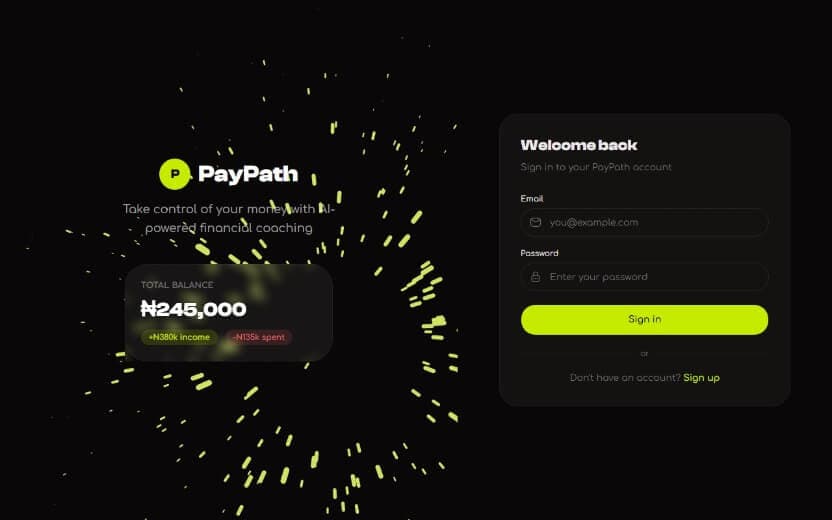
Most personal finance tools assume Western banking infrastructure that doesn't exist in Nigeria. PayPath was built for this market — manual income/expense tracking in Naira, savings goals, a financial health score based on habits rather than bureau reports, and an AI financial coach. 7-person team project where I overhauled the backend architecture, built the scoring system and AI coach, restructured the frontend state management, and handled the final QA pass. My contributions: ~7,100 lines across 97 files.
The Problem
Most personal finance tools are built for Western banking systems — they assume linked bank accounts, credit scores from bureaus, and stable monthly salaries. None of that maps to the Nigerian financial reality. People needed a tool that lets them manually log income and expenses in Naira, track savings goals with real progress, earn a financial score that reflects their habits (not a bureau report), and get personalized financial guidance without paying for a human advisor. There was no lightweight, mobile-first app doing all four well.
Screenshots
Challenges
Designing a financial health score that feels fair across income levels — someone saving ₦500/day needed to see the same sense of progress as someone saving ₦50,000. No existing standard existed for the Nigerian market.
The AI financial coach needed to give personalized advice grounded in the user's actual data, but also needed to deliver useful guidance when the AI service is unavailable — two complete advice engines that the user can't tell apart.
Heavy frontend modules (3D animations, charts) needed to run smoothly on mid-range Android devices — the typical hardware for the Nigerian market. A careless bundle would make the app unusable for its target users.
Solutions
Built a weighted composite scoring algorithm that measures savings consistency, budget adherence, and income regularity — income-agnostic by design. Tested against edge cases until the tiers felt fair across all income levels.
Built a dual-engine advice system: AI-powered personalized coaching as the primary path, with a rule-based engine as a seamless fallback. The user always gets actionable guidance regardless of service availability.
Used dynamic imports for heavy modules so they stay out of the initial bundle. Charts and 3D animations load on-demand with skeleton states, keeping the app responsive on lower-end hardware.
Key Highlights
Financial Passport Scoring: Income-agnostic scoring algorithm that measures savings consistency, budget adherence, and income regularity — with tiers and achievement badges that feel fair whether you save ₦500 or ₦50,000.
AI Financial Coach with Fallback: Personalized advice grounded in the user's real financial data. When the AI is unavailable, a rule-based engine delivers equally useful guidance seamlessly.
Nigerian-First Design: Naira currency, Paystack payments, manual transaction logging, and performance optimized for mid-range Android devices common in the target market.
Team Contribution: On a 7-person team, delivered the backend architecture, scoring system, AI integration, state management layer, and final QA — ~7,100 lines across 97 files.
Scale & Scope
~7,200
Total Lines of Code
~86
Source Files
10 pages, 20+ endpoints
Pages / Endpoints
4
Database Models
16 (mine)
Git Commits
Technology Stack
Outcome
Fully functional and deployed — backend on Railway with PostgreSQL, frontend on Vercel. Built for a real audience in the Nigerian market.